
They contend that what distinguishes humans from other animals is our innate sense of consciousness.
But we also know that animals may feel sympathy and compassion for other animals as well as for humans.
However, this is unlike anything I have ever seen.
Some animals are both prey and predators. Known as the King of the Jungle, lions are at the top of the food chain.
Considering their might and reputation as ferocious predators, one could assume that they are also mindless, cold-blooded creatures.
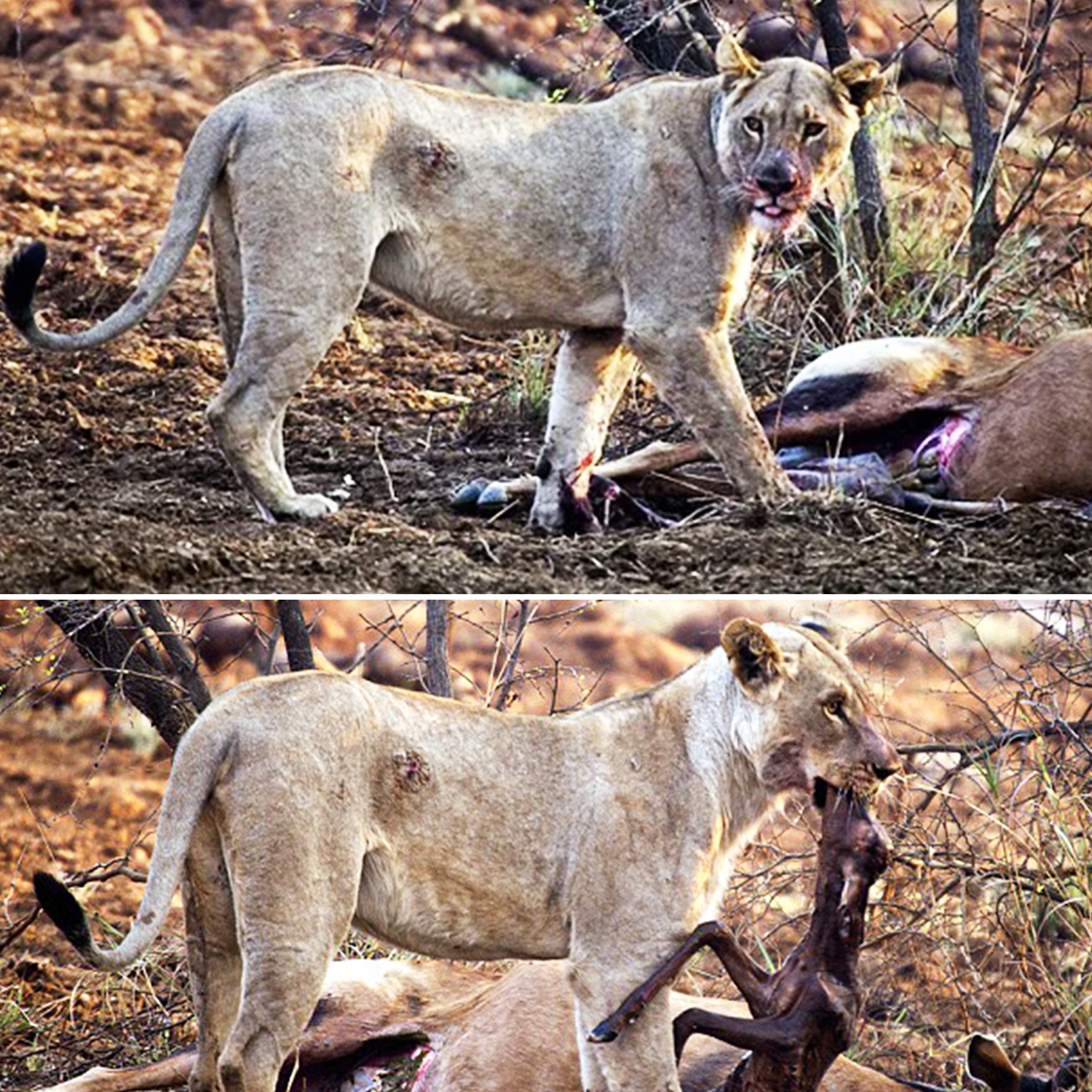
The incredible sights that a group of safari explorers witnessed in South Africa’s Madikwe Game Reserve have left the world in awe. The group encountered a lioness who had just hunted and captured a massive antelope while exploring the reserve.
But after catching and devouring her prey, she stopped suddenly because she had discovered the antelope’s unborn fetus within its abdomen.
What occurs next is simply amazing and only gets better. She immediately backs off and stops eating. She takes out the fetus and gently places it down, circling around it as though to see whether it’s still alive.
“I have seen a lion kill where the prey was pregnant, but usually they would just keep feeding as if nothing was wrong,” said tour guide Gerry Van Der Walt.
However, “the scenes that followed had us all dumbstruck” this time, he added. “The lioness carefully placed the fetus on the floor after it had been removed from the mother, and then spent a significant amount of time sniffing and exploring the unborn antelope.”

She laid the fetus very lightly on the floor, looking very nervous and disturbed and looking around all the time. “Then she nuzzled the fetus and gently rolled it over with her nose, then picked it up on the back of the neck like it was one of her own cubs,” Gerry continued.
When the lioness eventually appeared to realize the fetus was dead, she gently lifted it and struck it behind a bush, as if to give it a respectable spot to be buried. Then, as if grieving, she remained near.
We watched as she moved slowly toward the thicket and placed the fetus gently at the foot of the long grass. “She gave it a couple more nose pushes and kept looking around all the time as if she was expecting help or danger,” Gerry adds.
The lioness’s subsequent moves, which were already stunning, left the group of watchers even more in awe. She stopped feeding entirely and then simply lay down next to her victim as if she were experiencing regret and shame. She remained there for some time.

“I can honestly say that this was one of the most amazing examples of lion behavior I have ever witnessed.” What was she thinking? Why did she behave the way she did? Gerry ponders.
I find that to be quite clear. This amazing event proves that animals can feel empathy and even feel bad about what they did. Who could blame a lioness for pursuing her prey? It’s just the way things are. Even though it was a fairly natural activity, she felt bad about it after the fact and displayed incredible conduct that even we humans might be envious of!
Animals are amazing. Share this story if you agree with it.
